

Why cavity depth matters more than panel thickness: a 12 mm panel can swing NRC from 0.60 to 0.92
Cavity depth is the half of acoustic specification that gets ignored. Same panel, same material, different mounting. Same product can rate NRC 0.60 or 0.92. Built on KARIKA's 9 absorption curves from Intertek 2025.
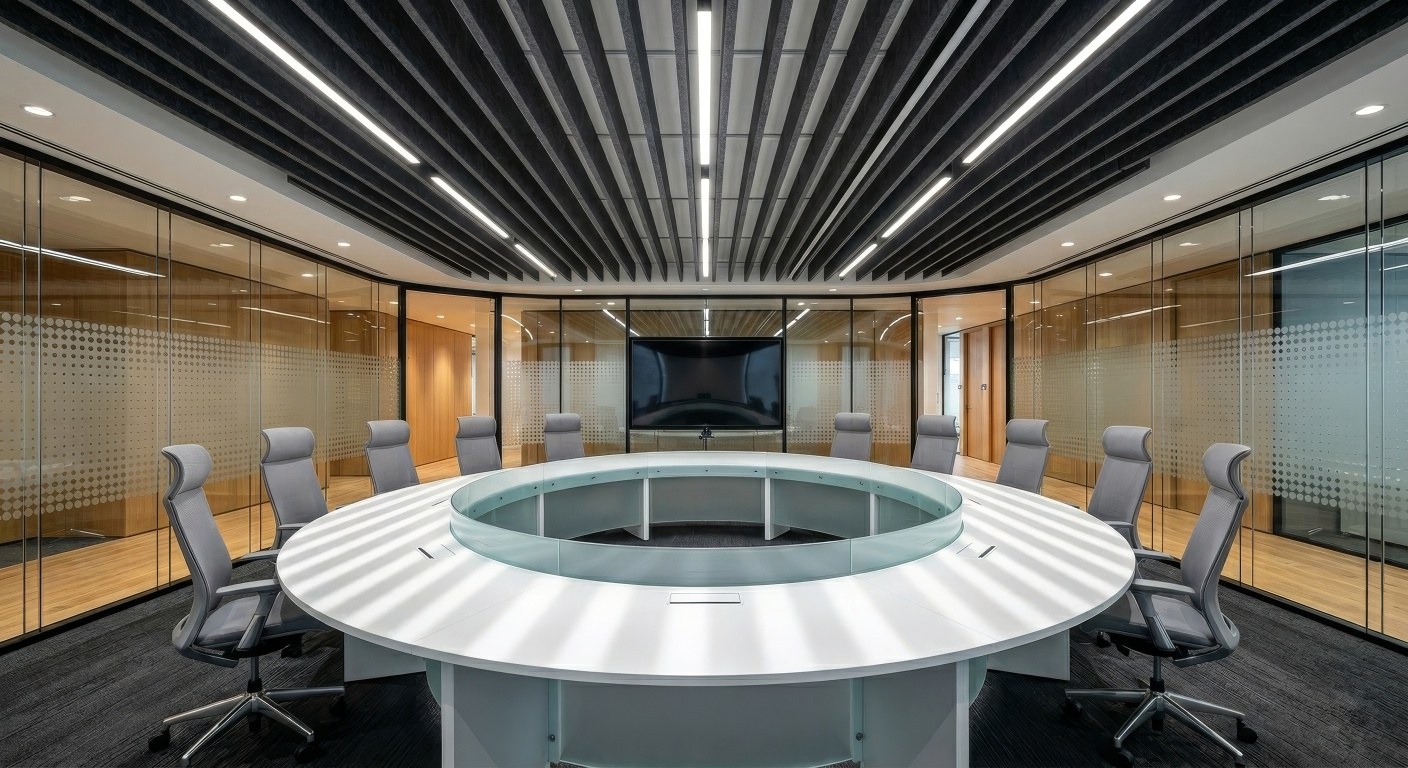
A 12 mm PET acoustic panel can rate NRC 0.60. The same panel, same batch, same material, can rate NRC 0.92. The difference is not the panel. It is the air gap behind it.
This is the single most under-specified variable in Indian acoustic projects. Architects pick a panel by its headline NRC, the contractor mounts it directly against the wall, and the room ends up nothing like the spec promised. The fix is in the drawing, not in the panel.
This article walks through the physics of cavity-backed absorption, what the actual numbers look like across a real product range, and how to specify cavity on your drawings so the install matches the brief.
Why cavity exists at all
Porous fibre absorbers work by friction. Sound waves enter the fibre matrix, the air molecules vibrate against the fibres, and energy converts to heat. The thicker the matrix, the more friction. So far, so simple.
But sound is a wave, not a particle. Each frequency has a wavelength. 1000 Hz is roughly 340 mm long. 250 Hz is roughly 1370 mm long. For a porous absorber to work at a given frequency, the fibre needs to interact with the wave at the point of maximum air velocity. For a wave reflecting off a hard wall, peak velocity sits a quarter-wavelength away from the wall. Not at the wall surface itself.
So a panel mounted directly against concrete catches sound at the wall surface, where velocity is at its lowest. The panel still works, but only at the higher frequencies whose quarter-wavelength is short enough to fall inside the panel’s thickness. Bass and lower mids pass through almost unaffected.
Add a cavity behind the panel and the physics change. The panel now sits closer to the velocity peak for lower frequencies. Mid and low frequencies get absorbed alongside the highs. Headline NRC climbs sharply.
This is why a thin panel with a deep cavity routinely outperforms a thick panel mounted direct.
The data, from our own test reports
We sent three thicknesses of plain PET acoustic panel (9, 12 and 24 mm) to Intertek Shanghai in March 2025 and ran them through ASTM C423-23 reverberation-room tests at three mounting conditions. Type A (direct mount, no cavity), Type E200 (200 mm cavity) and Type E400 (400 mm cavity). The full nine curves are published on the material page.
Headline numbers:
| Thickness | Type A (direct mount) | Type E200 (200 mm cavity) | Type E400 (400 mm cavity) |
|---|---|---|---|
| 9 mm | NRC 0.45 | NRC 0.80 | NRC 0.80 |
| 12 mm | NRC 0.60 | NRC 0.85 | NRC 0.92 |
| 24 mm | NRC 0.75 | NRC 0.90 | NRC 0.90 |
A few observations from this table that matter for spec writing.
1. Cavity beats thickness, until it doesn’t. A 12 mm panel at 400 mm cavity (NRC 0.92) outperforms a 24 mm panel at direct mount (NRC 0.75). You can save material cost and weight by using a thinner panel with a deeper cavity, where ceiling height allows.
2. Cavity gains plateau. Going from 200 mm to 400 mm cavity adds little or nothing for the 9 mm and 24 mm panels. The 12 mm panel does still gain (0.85 to 0.92), because the additional cavity catches more of the low-frequency absorption. After about 200 mm, you are buying diminishing returns for most office and education work.
3. The 9 mm panel hits a ceiling. Below a certain mass, the panel cannot absorb the higher frequencies fully no matter how much cavity you give it. NRC 0.80 is roughly the ceiling for 9 mm. Specify 12 mm or 24 mm if you need more.
What “Type A” and “Type E400” actually mean
These are the standard mounting conditions defined by ASTM C423-23. They are how labs compare panels on a level field. They are also exactly how a contractor will install your panels, if you specify them correctly.
- Type A. Panel laid flat on a hard reflective surface. No cavity. This simulates direct-fix wall and ceiling installs. It is the lowest-NRC condition for a given panel.
- Type E200. Panel suspended over a 200 mm air cavity. Common for suspended ceilings with shallow plenum depth.
- Type E400. Panel suspended over a 400 mm air cavity. Common for tall suspended ceilings with deep plenum.
The mounting condition appears in the test report. If a manufacturer quotes an NRC without naming the mounting type, the number is unverified. Always ask.
When you write the panel into your drawings, write the mounting condition alongside it. “Acoustic panel, KARIKA 12 mm plain, NRC 0.85 at Type E200 mounting.” That is a contractor brief. “Acoustic panel, KARIKA 12 mm plain, NRC 0.85” is incomplete and the contractor will mount it whichever way is cheapest.
Cavity depth and frequency: where the bass lives
Headline NRC averages four frequencies (250, 500, 1000 and 2000 Hz). It does not capture what happens below 250 Hz, where bass and male voices live. Cavity depth is what controls that band.
Approximate quarter-wavelength distances (the velocity peak for each frequency):
| Frequency | Wavelength | Quarter-wavelength (cavity depth needed for peak absorption) |
|---|---|---|
| 2000 Hz | 170 mm | 43 mm |
| 1000 Hz | 340 mm | 85 mm |
| 500 Hz | 680 mm | 170 mm |
| 250 Hz | 1370 mm | 343 mm |
| 125 Hz | 2740 mm | 685 mm |
The pattern is direct. A 50 mm cavity catches up to 2000 Hz well. A 200 mm cavity catches down to 500 Hz. A 400 mm cavity catches down to 250 Hz. To absorb 125 Hz fully you need close to 700 mm of cavity, which most architectural projects cannot afford in ceiling height.
Practical takeaway. For meeting rooms and conference rooms (where male voices around 125 Hz dominate), specify the deepest cavity you can afford. For coffee shops and open offices (where the noise is broadband but mostly above 500 Hz), 100 to 200 mm cavity is enough.
Three places cavity gets ignored on Indian projects
1. Direct-fix wall panels in conference rooms. A common spec. The architect picks a 12 mm panel rated NRC 0.85 (E200) and the contractor mounts it directly to the gypsum board with adhesive. The panel now performs at NRC 0.60. The room sounds boomy. The architect blames the panel.
The fix is to detail a battened sub-frame that creates a cavity behind the panel. Even a 25 mm cavity adds significant absorption. 50 mm is better. 100 mm with mineral wool fill is excellent and still achievable on most walls without losing usable space.
2. Suspended ceiling tiles installed against the slab. A grid ceiling installed at slab height has zero cavity. The “suspended” tiles are doing direct-mount absorption. NRC drops from the brochure number to roughly half.
The fix is a real plenum. 100 mm minimum, 200 mm if you want the panel to perform as labelled. Existing buildings often have services in the way. Coordinate the acoustic spec with the M&E plan early.
3. Baffles hung tight to the slab. Suspended acoustic baffles work best when they have air on both sides and the room above acts as the cavity. Hung tight to the slab, they only absorb on one face and lose roughly half their absorption.
The fix is to suspend baffles at least 100 mm below the slab. 200 to 400 mm is better. The room above the baffle becomes part of the absorber, so headline NRC stays close to the lab number.
Practical specification, by room type
For typical Indian projects, the cavities that actually deliver in the field:
| Room type | Recommended cavity | Recommended panel | Expected NRC |
|---|---|---|---|
| Meeting room (12 person) | 100 mm wall cavity | 12 mm plain | 0.85 |
| Conference room | 200 mm wall cavity | 12 mm plain | 0.92 |
| Open-plan office (ceiling) | 200 mm plenum | 12 mm plain | 0.85 |
| Open-plan office (back wall) | 100 mm wall cavity | 12 mm plain | 0.85 |
| Auditorium back wall | 200 to 400 mm cavity | 24 mm plain | 0.92 |
| Classroom | 100 mm plenum | 12 mm plain | 0.85 |
| Restaurant ceiling | 100 mm plenum | 12 mm plain | 0.85 |
For most of the above, our 12 mm plain acoustic sheet is the working choice. Stocked in 94 colours, dispatched same day in Bangalore on payment, delivered anywhere in India within a week. No customisation, no lead time.
For 24 mm work and bespoke ceiling forms (baffles, clouds, faceted reliefs), turnaround is 4 to 8 weeks depending on the configuration.
Final note
Cavity is half the spec. Treat it that way on your drawings, your contractor brief, and your conversations with the panel manufacturer. The same product can sound very different in two different rooms because the install was different. The data is published, the physics is well understood, and the only thing left is to write it down before the contractor mounts the first panel.
For the full nine-curve absorption data behind the numbers in this article, see the material page NRC chart. For project conversations or a sample box, write to the studio or request samples.