


 GRS
GRS GRS 4.0
Global Recycled Standard 4.0, Intertek-issued. Verifies 75% post-consumer recycled PET content and the chain of custody from fibre through to finished panel.
Cert # ITS-TE-00031312-GRS-02768200 · License TE-00035112

KARIKA / The material
The materialCrafted from discarded drinking bottles. Free of formaldehyde and other chemical binders. Low embodied energy, healthier indoor air. Scroll to see how the material is made, how it absorbs sound, how it burns, and how it ages.
Every KARIKA panel begins as discarded drinking bottles. Ten precise steps turn post-consumer PET into 100% polyester fibre. Heat-bonded, zero binders, low embodied energy, fully recyclable. Scroll to follow the journey.
Stage
Post-consumer plastic drinks bottles, sourced from waste streams. The chain of custody from bottle to baled fibre is documented under the Global Recycled Standard 4.0, audited annually by Intertek.
PET separated from other plastics, then divided by colour using optical scanners and air jets. Clear bottles are kept for the highest-grade fibre stream.
Bottles broken into small fragments called flakes. Each flake is roughly the size of a fingernail.
Flakes cleaned to remove labels, residue, and heavier plastics. Float-sink separation drives out PVC, polypropylene and aluminium fragments.
Flakes dried with air jets, separating any remaining contaminants. Moisture is driven below 50 ppm before pelletising.
Clear white flakes separated from coloured ones, then gathered for the next stage. The clear stream produces the highest tensile fibre.
Heated, extruded into spaghetti strands, cooled, and cut into pellets. The pellets become the feedstock for the spinning line.
Granules pushed through fine spinnerets to form a continuous filament. The filament is then crimped, cut to staple length, and baled.
100% recycled polyester fibre. Soft, lightweight, ready to bond. Three-quarters of the fibre that enters a KARIKA panel arrives in this form; the remaining quarter is virgin PET binder fibre with a lower melting point. Both are pure PET.
Layers of fibre are needled into a felt and passed through a heated press. The binder fibre softens and locks the structure. Mechanical and thermal bond only. No resin, no glue, no chemical binder. Cut to specification.
Twelve qualities that make KARIKA a reliable specification. Acoustically performant, materially honest, and quietly designed for the spaces architects build.
What it does to sound, vibration and heat.

NRC up to 1.00 with cavity. Absorbs reverberation across the speech range.

Layered fibre dampens impact and structure-borne sound.

Thermal insulator. Contributes to building energy performance.
Materially honest. Recycled, fire-safe, zero off-gassing.

75% post-consumer recycled PET. Fully recyclable at end of life.

Naturally fire-resistant. No chemical retardants required.

Zero volatile organic compounds. Heat-bonded, no chemical binders.
94 colours, accepts print, is tackable.

94 colours. Grooves, CNC patterns, 3D embossed and printed finishes.

Surface accepts direct digital print and custom graphic application.

Holds pins. Doubles as a wall and a pinboard.
What a contractor needs to handle on site.

2000 / 2400 / 4000 GSM at 9 / 12 / 24 mm. Easy to handle and suspend overhead.

Direct-fix, suspended or framed. Cuts cleanly with a router or a sharp blade.

Open fibre lets air move through. Resists moisture and bacteria.
PET felt has a porous fibre matrix. Air moves through the fibres and loses energy as friction. The room hears less noise, less echo, less reverberation. Headline NRC depends as much on the air gap behind the panel as on the panel itself. Used in offices, classrooms, hospitals and auditoriums.
A single number summarising absorption from 250 to 2000 Hz. The current Intertek test report (March 2025) covers three panel thicknesses across three mounting conditions. From a panel laid flat on the slab (Type A) to a panel suspended above a 200 mm or 400 mm cavity.
Polyester felt absorbs by friction. The bigger the air gap behind the panel, the more bass and mid-bass it can pull down. Which is why a 12 mm panel on a slab rates NRC 0.60, but the same panel suspended over 150 mm of air rates 0.92. Cavity is the unsung half of acoustic specification.
| Mounting | 9 mm | 12 mm | 24 mm |
|---|---|---|---|
| Direct mount (no cavity) | NRC 0.45 | NRC 0.60 | NRC 0.75 |
| 50 mm cavity | NRC 0.70 | NRC 0.80 | NRC 0.90 |
| 100 mm cavity | NRC 0.80 | NRC 0.90 | NRC 0.95 |
| 150 mm cavity | NRC 0.85 | NRC 0.92 | NRC 1.00 |
| 200 mm cavity | NRC 0.80 | NRC 0.85 | NRC 0.90 |
| 400 mm cavity | NRC 0.80 | NRC 0.85 | NRC 0.90 |
A useful rule of thumb: the panel begins to absorb meaningfully at frequencies whose wavelength is roughly four times the cavity depth. A 200 mm cavity therefore handles mid-range conversation well; a 400 mm cavity reaches into the bass that makes a concrete slab ring.
The full sound-absorption curve from 100 Hz to 5000 Hz, across the three mounting conditions Intertek tested in March 2025. Use the pills below the chart to isolate one curve at a time. Hover for individual coefficients; scroll the table for the raw octave-band values.
| Mounting | 100 | 125 | 160 | 200 | 250 | 315 | 400 | 500 | 630 | 800 | 1k | 1.25k | 1.6k | 2k | 2.5k | 3.15k | 4k | 5k | NRC |
|---|---|---|---|---|---|---|---|---|---|---|---|---|---|---|---|---|---|---|---|
| No cavity | 0.03 | 0.02 | 0.03 | 0.02 | 0.05 | 0.09 | 0.13 | 0.17 | 0.30 | 0.44 | 0.58 | 0.70 | 0.81 | 1.00 | 1.10 | 1.10 | 1.10 | 1.10 | 0.45 |
| 50 mm | 0.09 | 0.09 | 0.16 | 0.23 | 0.29 | 0.39 | 0.54 | 0.68 | 0.78 | 0.86 | 0.95 | 0.97 | 1.00 | 0.95 | 0.89 | 0.81 | 0.91 | 0.62 | 0.70 |
| 100 mm | 0.21 | 0.26 | 0.39 | 0.49 | 0.55 | 0.72 | 0.88 | 0.91 | 0.97 | 0.98 | 0.98 | 0.89 | 0.75 | 0.76 | 0.88 | 0.87 | 0.92 | 0.73 | 0.80 |
| 150 mm | 0.27 | 0.42 | 0.59 | 0.67 | 0.74 | 0.88 | 0.97 | 0.96 | 0.99 | 0.93 | 0.79 | 0.72 | 0.86 | 0.83 | 0.85 | 0.89 | 0.94 | 0.78 | 0.85 |
| 200 mm | 0.25 | 0.37 | 0.39 | 0.64 | 0.76 | 0.82 | 0.84 | 0.96 | 0.89 | 0.79 | 0.67 | 0.76 | 0.80 | 0.80 | 0.83 | 0.88 | 0.87 | 0.83 | 0.80 |
| 400 mm | 0.35 | 0.59 | 0.54 | 0.66 | 0.80 | 0.75 | 0.74 | 0.67 | 0.76 | 0.80 | 0.79 | 0.82 | 0.84 | 0.84 | 0.85 | 0.92 | 0.96 | 0.99 | 0.80 |
| Mounting | 100 | 125 | 160 | 200 | 250 | 315 | 400 | 500 | 630 | 800 | 1k | 1.25k | 1.6k | 2k | 2.5k | 3.15k | 4k | 5k | NRC |
|---|---|---|---|---|---|---|---|---|---|---|---|---|---|---|---|---|---|---|---|
| No cavity | 0.03 | 0.02 | 0.02 | 0.06 | 0.10 | 0.13 | 0.21 | 0.30 | 0.50 | 0.67 | 0.86 | 0.99 | 1.10 | 1.10 | 1.10 | 1.10 | 1.10 | 1.10 | 0.60 |
| 50 mm | 0.10 | 0.10 | 0.19 | 0.26 | 0.34 | 0.45 | 0.63 | 0.79 | 0.90 | 1.00 | 1.04 | 1.04 | 1.04 | 1.04 | 1.04 | 0.94 | 1.04 | 0.72 | 0.80 |
| 100 mm | 0.24 | 0.29 | 0.44 | 0.55 | 0.62 | 0.81 | 0.99 | 1.02 | 1.09 | 1.10 | 1.10 | 1.00 | 0.84 | 0.86 | 0.99 | 0.98 | 1.04 | 0.82 | 0.90 |
| 150 mm | 0.30 | 0.47 | 0.65 | 0.74 | 0.82 | 0.98 | 1.07 | 1.06 | 1.10 | 1.03 | 0.88 | 0.80 | 0.95 | 0.92 | 0.94 | 0.99 | 1.04 | 0.86 | 0.92 |
| 200 mm | 0.29 | 0.39 | 0.45 | 0.61 | 0.74 | 0.81 | 0.88 | 0.95 | 0.86 | 0.78 | 0.72 | 0.81 | 0.87 | 0.89 | 0.89 | 0.92 | 0.98 | 0.94 | 0.85 |
| 400 mm | 0.42 | 0.58 | 0.57 | 0.75 | 0.74 | 0.76 | 0.78 | 0.75 | 0.78 | 0.85 | 0.93 | 0.91 | 0.93 | 0.90 | 0.96 | 0.92 | 0.98 | 0.97 | 0.85 |
| Mounting | 100 | 125 | 160 | 200 | 250 | 315 | 400 | 500 | 630 | 800 | 1k | 1.25k | 1.6k | 2k | 2.5k | 3.15k | 4k | 5k | NRC |
|---|---|---|---|---|---|---|---|---|---|---|---|---|---|---|---|---|---|---|---|
| No cavity | 0.05 | 0.02 | 0.07 | 0.12 | 0.18 | 0.31 | 0.45 | 0.62 | 0.82 | 0.94 | 1.07 | 1.10 | 1.10 | 1.10 | 1.10 | 1.10 | 1.10 | 1.10 | 0.75 |
| 50 mm | 0.12 | 0.12 | 0.21 | 0.32 | 0.40 | 0.53 | 0.75 | 0.94 | 1.07 | 1.10 | 1.10 | 1.10 | 1.10 | 1.10 | 1.10 | 1.10 | 1.10 | 0.85 | 0.90 |
| 100 mm | 0.25 | 0.31 | 0.46 | 0.58 | 0.66 | 0.85 | 1.04 | 1.08 | 1.10 | 1.10 | 1.10 | 1.06 | 0.89 | 0.90 | 1.04 | 1.03 | 1.09 | 0.86 | 0.95 |
| 150 mm | 0.33 | 0.50 | 0.70 | 0.81 | 0.89 | 1.06 | 1.10 | 1.10 | 1.10 | 1.10 | 0.95 | 0.86 | 1.03 | 1.00 | 1.02 | 1.07 | 1.10 | 0.94 | 1.00 |
| 200 mm | 0.35 | 0.38 | 0.41 | 0.62 | 0.80 | 0.84 | 0.86 | 0.99 | 0.96 | 0.86 | 0.81 | 0.91 | 0.91 | 0.91 | 0.93 | 0.97 | 0.99 | 0.96 | 0.90 |
| 400 mm | 0.38 | 0.64 | 0.61 | 0.67 | 0.83 | 0.87 | 0.80 | 0.87 | 0.87 | 0.90 | 0.90 | 0.96 | 0.94 | 0.93 | 0.94 | 1.02 | 1.02 | 1.08 | 0.90 |
Polyester does not catch fire easily; it melts and self-extinguishes. The panel is rated B-s1, d0 under EN ISO 11925-2:2020 (ignitability) and EN 13823:2020+A1:2022 (single burning item). The European reaction-to-fire classification for construction products.
Translated: limited contribution to fire (B), very low smoke emission (s1), no flaming droplets (d0).
Achieved without flame retardants. No phosphorus-based or halogenated chemistry is added at any stage of manufacture. The rating is intrinsic to the polymer.
For Indian and US-coded specifications, the panel is supplied to either
Class A or Class B ratings on request.
The choice is made at order, not at install.
PET acoustic is dimensionally stable and chemically inert. Colour is dyed into the fibre before it is spun, not surface-printed. It does not lift, mark from contact, or fade under normal interior light.
KARIKA panels are pressed and finished by people, not robots. Five things to expect in every shipment. Written here so they don't come as a surprise on site.
The fibre is dyed before spinning, and small variations in dye-lot saturation carry through the panel. Specify the full wall from a single production run and the wall reads as one surface. Order a sample chip from the same batch as your delivery if a colour-critical install is planned.
Fibre composition and surface texture fluctuate within tolerance. That variation is what makes felt read as felt rather than as plastic. The grain and the slight nap are the material's signature, not its flaw.
The press settles each panel to its specified thickness, and minor substrate unevenness is normal. Specify shadow gaps, reveal details, or trim profiles that tolerate a millimetre rather than fight it.
Like a textile or a timber veneer, KARIKA panels have an inherent grain. For ease of correct orientation during installation, panels without the KARIKA® logo are marked in the corner. Hang them all the same way for an unbroken read.
Panels should be inspected at delivery and before fitting. Once a panel has been cut, drilled, glued or hung, claims relating to surface, colour or dimension cannot be entertained. The moment of installation is the moment of acceptance.
Issuing body, scope, certificate number and credit pathway for each one.
In the language a green-building consultant will recognise on the first read.
GRS Global Recycled Standard 4.0, Intertek-issued. Verifies 75% post-consumer recycled PET content and the chain of custody from fibre through to finished panel.
Cert # ITS-TE-00031312-GRS-02768200 · License TE-00035112 OEKO100
 TESTEX AG-issued, Class I (baby articles). The strictest tier. Verifies the panel is free of harmful substances at the level required for items in skin contact with infants.
Cert SH001 252785 · valid 15.01.2026 GRA
GRA Global GreenTag GreenRate Level A. The highest tier. The pathway by which LEED, WELL and Green Star recognise Sustainable Products credits.
LEED · WELL · Green Star · valid 8 April 2026 PHD
PHD Product Health Declaration at Platinum tier. Full ingredient disclosure and risk assessment under GGT International v4.1.
Cert KKS:SZ01:2025:PH · valid 8 April 2026Reverberation-room sound-absorption testing at Intertek under ASTM C423-23. Three panel thicknesses (9, 12, 24 mm) across multiple mounting conditions. Per-frequency absorption curves above; full reports available on request.
ASTM C423-23 · reverberation room ARAI
ARAI Earlier reverberation-room test by the Automotive Research Association of India under ASTM C423-22 (August 2025). Available on request alongside the current Intertek 2025 reports.
Report ULR-TC55652550006032F · NVH/3100/02543Material Ingredients credit. Option 1 (Material Ingredient Reporting) and Option 2 (International ACP. REACH). Contributes via GreenRate and the PHD.
MR Credit · Material Ingredientsv1.0: Features 04, 11, 25, 26, 97. v2.0: X07 Materials Transparency, X08 Materials Optimisation, plus X01, X05, X06.
Materials Transparency & OptimisationSustainable Products credit and Procurement and Purchasing credit, contributed via the GreenRate Level A pathway.
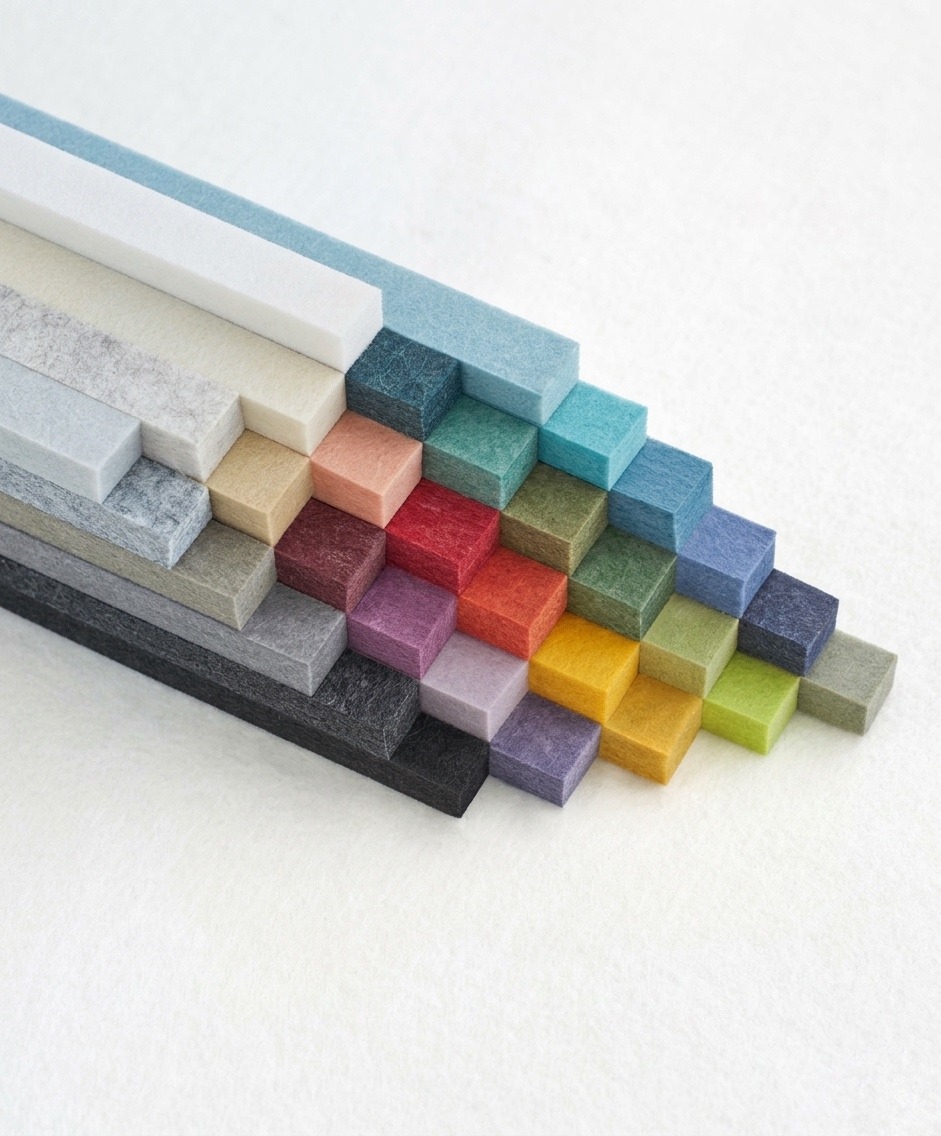
Sustainable Products · ProcurementThe full standard range, codes KA-7901 to KA-7995. Click any tile for a larger view. Physical swatches are posted by the studio at no cost within India.