

Acoustic panels vs soundproof panels — what's the difference, and which one do you actually need?
The most-confused pair of terms in acoustic specification. Why acoustic panels and soundproof panels solve completely different problems, how to tell which one your room needs, and what each one actually costs to install in India.
Of all the conversations I have with architects, contractors, and homeowners every week, the most common starts the same way. Someone has a noise problem. They have heard the words “acoustic” and “soundproof” both used to describe the solution. They use them interchangeably. And when the panels arrive, they discover that the product solved a problem they did not have, and did nothing for the problem they did.
Acoustic panels and soundproof panels are not the same product. They are not even close. They solve two completely different physical problems, they are made of different materials, they look different, they cost different amounts, and using one when you need the other is the most expensive mistake in this category.
Here is the difference, the simple test that tells you which you need, and what each one actually does.
The two-sentence version
Acoustic panels absorb sound inside a room. They reduce echo and reverberation. They are used when the room sounds bad — voices ring, music smears, conversation feels effortful.
Soundproof panels block sound between rooms. They reduce the noise that passes through a wall, ceiling, or floor. They are used when you can hear what is happening in the next room — a neighbour’s TV, traffic outside, the gym above your bedroom.
If you cannot remember anything else from this article, remember this: echo problem = acoustic panels. Privacy problem = soundproof panels. That single test gets the right answer 95 percent of the time.
The physics, in plain English
Sound is energy. When that energy reaches a surface, three things can happen to it:
- Reflection — the sound bounces off. This is what hard surfaces (glass, concrete, plaster, tile) do. Most of the energy goes back into the room.
- Absorption — the sound enters the surface and is converted into heat through friction. Porous, fibrous materials do this. The room is left quieter.
- Transmission — the sound passes through the surface to the other side. Light, thin partitions transmit a lot. Heavy, dense, sealed barriers transmit very little.
Acoustic panels are engineered to maximise absorption — option 2. They are soft, porous, fibrous, and lightweight. Sound enters the fibre matrix, scatters, loses energy through friction, and dies. The room behind the panel becomes quieter, in the sense that the sound stops ringing around inside it.
Soundproof panels (more accurately called sound insulation, isolation, or barriers) are engineered to minimise transmission — option 3. They are dense, heavy, sealed, and often layered. Sound hits the barrier and most of its energy reflects back into the room of origin. Very little gets through to the room on the other side.
The two work against each other. A material that is very good at absorbing — like polyester felt — is light, porous, and lets sound through almost as easily as it absorbs it. A material that is very good at blocking — like mass-loaded vinyl or layered drywall — is dense and smooth and reflects sound, making the room it is in louder, not quieter.
That is why a recording studio uses both. The walls are mass-loaded to keep outside noise out, and covered in absorbent panels so the room itself sounds clean. Two products solving two problems in the same building.
The quick test — which one do you need?
Three questions:
1. Is the noise happening inside this room, or coming from outside?
- Inside (people talking, music playing, your own voice ringing) → acoustic
- Outside (neighbour, traffic, footsteps above) → soundproof
2. When the room is quiet, is it actually quiet?
- Yes, when nobody’s making noise, it’s silent → you have an echo problem when people do talk. Acoustic.
- No, even with the door closed and nobody talking, you can still hear the street/TV/neighbour → soundproof.
3. Is the goal to make conversation clearer, or to keep sound from leaving/entering?
- Clearer conversation, less reverb → acoustic
- Privacy, isolation, less bleed → soundproof
If you answered “inside / yes / clearer” — you need acoustic panels. Polyester felt, PET, fibreglass, or mineral wool, applied as wall panels, ceiling baffles, or clouds.
If you answered “outside / no / privacy” — you need soundproofing. That is a construction problem, not a finishes problem. It usually means adding layered drywall, mass-loaded vinyl, decoupled wall framing, or replacing single-glazed windows with laminated double glazing.
Why they look completely different
A useful tell: just look at the product.
Acoustic panels are soft and fibrous. You can press your finger into them. They are typically 9 to 50 mm thick. They are lightweight — a 2-metre sheet of 12 mm polyester acoustic felt weighs about 5 kg. The cross-section, if you cut one open, looks like a dense mat of pressed fibres with millions of tiny air pockets. The whole point of the material is the air inside it.
Soundproof barriers are dense and solid. You cannot compress them. They are typically much heavier per square metre — a sheet of mass-loaded vinyl can weigh 10 kg/m². The cross-section is smooth, uniform, sometimes layered (e.g., mass-loaded vinyl sandwiched between two layers of drywall). There are no air pockets. The whole point is the mass.
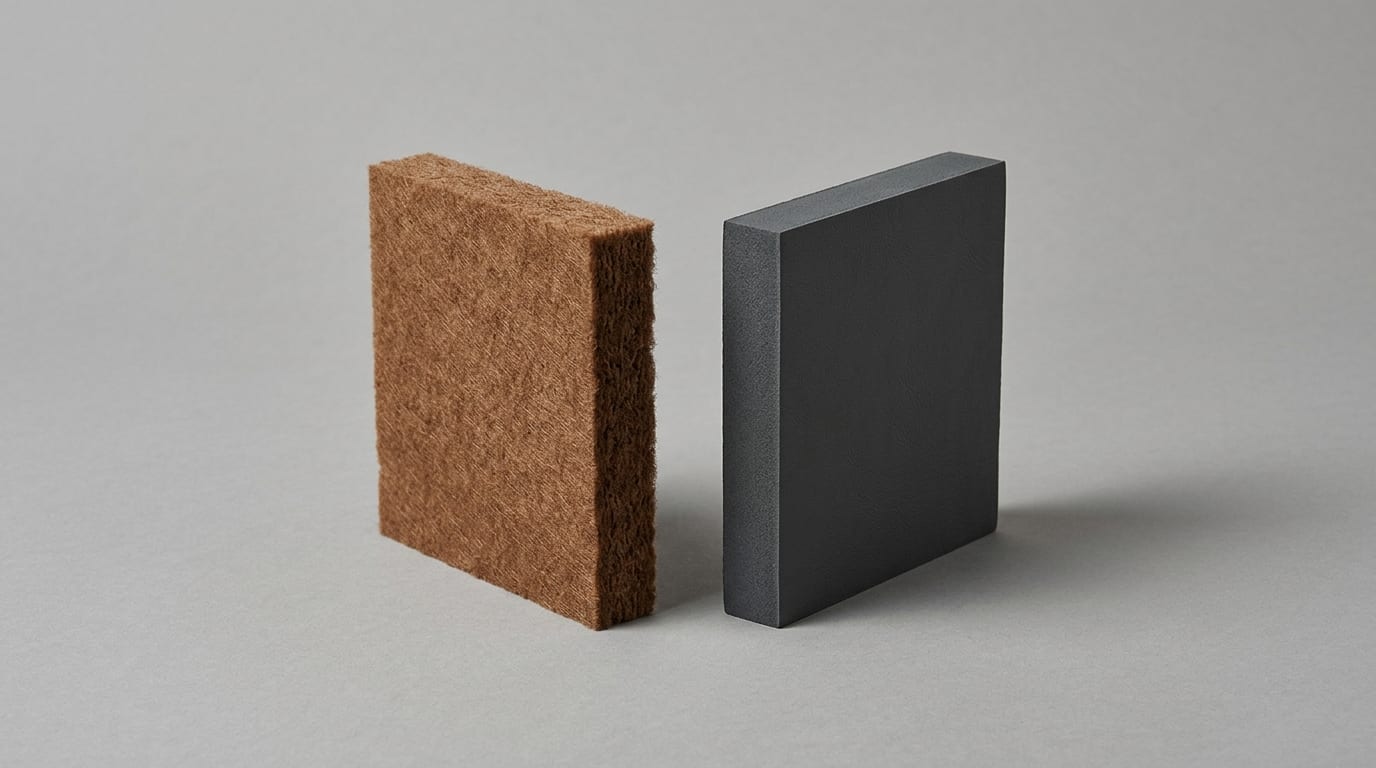
The image at the top of this article shows the two materials side by side. The umber block is polyester acoustic felt — light, fibrous, absorbent. The charcoal slab is a soundproof barrier — dense, smooth, heavy. They could not be more visually different, because they do not do the same thing.
When to use which — Indian context
Acoustic panels are right for:
- Offices with echo across open floors
- Conference rooms and boardrooms with voice ringing
- Meeting cabins and phone booths where speech needs to be clean
- Restaurants with too much chatter
- Home theatres where reflections muddy the audio
- Recording studios (for room sound, alongside soundproofing)
- Auditoria and lecture halls
- Classrooms
- Yoga studios, meditation rooms
Soundproofing is right for:
- A bedroom that hears the street
- A meeting room next to a noisy corridor
- A home theatre that disturbs the neighbours
- An apartment where you can hear the unit above walking around
- A clinic or consult room where conversation privacy is legally required
- Recording studios (for isolation, alongside acoustic treatment)
- A residential window facing a flyover
Notice the overlap. Some rooms need both. A serious home theatre needs soundproof construction (so the bass doesn’t shake your neighbour’s wall) and acoustic treatment (so the sound inside is clean). A boardroom on a busy corridor needs soundproof construction at the door and walls (so confidential meetings stay confidential) and acoustic panels (so the conversation inside is intelligible).
Cost comparison — India, 2026
Rough working numbers per square metre, materials only:
| Product | Cost (₹/m²) | Use |
|---|---|---|
| Polyester acoustic felt panel, 9 mm | ₹450 – ₹650 | Echo reduction |
| Polyester acoustic felt panel, 12 mm | ₹650 – ₹900 | Echo reduction |
| Grooved or 3D acoustic wall, 12 mm | ₹1,100 – ₹1,800 | Echo reduction, decorative |
| Suspended ceiling baffle, polyester felt | ₹900 – ₹1,400 | Echo reduction overhead |
| Mass-loaded vinyl, 5 mm | ₹600 – ₹900 | Soundproof — barrier layer |
| Double layer 12.5 mm acoustic drywall + green glue | ₹1,800 – ₹2,400 | Soundproof — full wall build-up |
| Laminated double-glazed window | ₹4,500 – ₹8,500+ | Soundproof — external noise |
The big delta is in labour and construction. Acoustic panels are a finishes spec — they sit on top of an existing wall and the installation is usually a day’s work for two people. Soundproofing is a construction spec — it usually means tearing into the wall, adding layers, decoupling, sealing every gap. Soundproof projects are 3-5x the total cost of acoustic projects for the same square metre of treated surface.
This is the second-most expensive mistake in the category — assuming “soundproofing” is something you add on top of an existing finished room. In almost every case it is not. It is a construction-stage decision. If you have already painted and moved in, it is usually too late and too expensive to retrofit serious soundproofing.
The truth most contractors don’t tell you
Three honest things:
1. No acoustic panel “soundproofs” a room. If a salesperson tells you a 12 mm felt panel will stop the neighbour’s TV, they are either lying or confused. It will not. The physics doesn’t allow it. You need mass to block sound, and a 12 mm felt panel has almost none. We sell felt panels and we will tell you the same thing.
2. Most “echo” complaints are not actually about volume. They are about clarity. People assume the room is loud, but the real problem is that voices smear together because of reverberation. Treating the room with absorption makes individual voices easier to pick out, even though the total energy in the room is the same. The room feels quieter without actually being quieter in dB terms.
3. You probably don’t need as much soundproofing as you think. Most “privacy” complaints in Indian offices can be solved by adding acoustic treatment to the corridor or open zone outside the cabin, not by reinforcing the cabin walls. A reverberant corridor amplifies every voice that passes through it. Treating the corridor often resolves what felt like a leaky-wall problem without touching the wall.
The simplest practical move
If you have an echo problem inside a single room — clattering, ringing, conversations that feel effortful — you need acoustic panels. Polyester acoustic wall panels or ceiling baffles and clouds. It is a one-day install, no construction, and the result is immediate.
If you have a privacy problem between two rooms — sound leaking through a wall — acoustic panels alone will not fix it. You need to look at the wall build-up itself. Talk to an acoustic consultant or a contractor who has done isolation work specifically. We can recommend one if you write to us.
If you have both problems, do the construction work first (during build) and the acoustic treatment second (after finishes). Doing them in the other order means tearing the panels off the wall to rebuild it.
For sample swatches of our polyester acoustic felt and a no-cost room estimate, request a sample box or write to the studio. Both reach the same inbox.
Echo is bouncing sound — fix it with absorption. Privacy is transmitted sound — fix it with mass. Two problems. Two products. Don’t mix them up.