

How to reduce echo in a room — a practical guide for offices, home theatres and meeting rooms (2026)
Where echo comes from, how to diagnose it, how much treatment your room actually needs, and where to put the panels. Written for offices, home theatres, restaurants and meeting rooms in India.
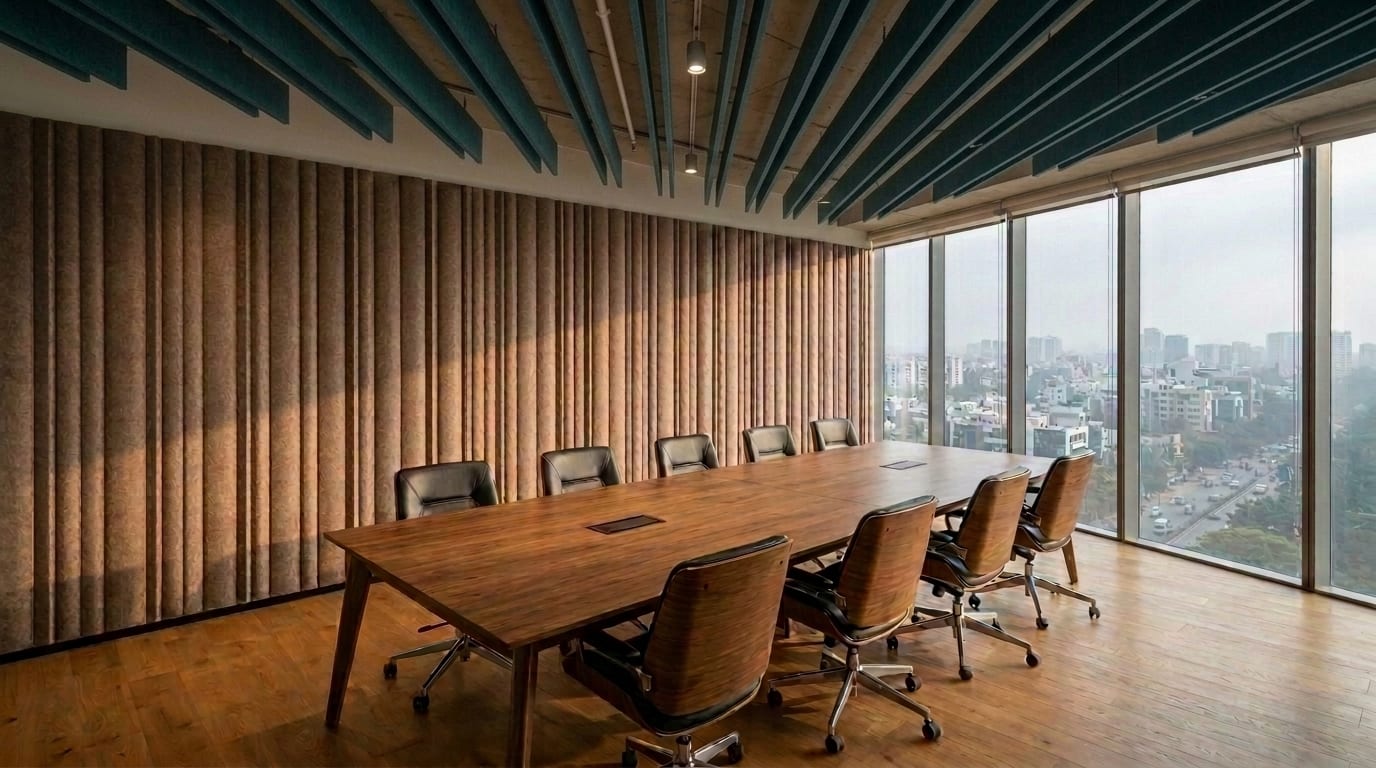
You walked into the room and noticed it before anyone said anything. The voices ring slightly. Footsteps clatter. Two people are talking at the next table and you can hear every word as if they were sitting beside you. The room has echo.
Echo, in the acoustic sense, is sound bouncing off the surfaces of a room and arriving at your ear a fraction of a second after the original. The technical name is reverberation. The longer it takes that sound to die away, the harder the room is to listen in. Speech becomes muddy. Music loses its detail. A conversation that should feel intimate ends up feeling like you’re shouting through a stairwell.
The good news is that echo is the simplest acoustic problem to fix. You do not need new walls, isolation, or anyone breaking the floor open. You need absorption — material that catches sound instead of bouncing it back. This guide explains how to figure out how much you need, where to put it, and what to avoid spending money on.
Why your room echoes
Sound is energy. When you speak, that energy travels outward as pressure waves. The waves hit hard, smooth, dense surfaces and bounce — exactly like light bouncing off a mirror. Plaster walls, glass partitions, polished stone floors, gypsum ceilings, marble counters: each one reflects almost all of the sound back into the room. With nothing to slow it down, that sound bounces back and forth until friction eventually wears it out. In an untreated office or boardroom, that can take three to five seconds. Long enough for the next syllable to overlap the previous one.
A “well-tuned” room — the kind that feels easy to talk in — usually has a reverberation time of 0.4 to 0.6 seconds. A recording studio aims for 0.2. Most untreated Indian offices and meeting rooms sit at 1.2 to 2.0. That is where the discomfort comes from. The room is technically loud even when no one is speaking — the previous syllable is still in the air.
Diagnose the room first
Walk in and clap your hands once, sharply. Listen for the tail.
- A clean, dry clap with no ring → the room is well-treated already
- A short clap-ack → mild echo, often acceptable for casual spaces
- A clap-aaaak with a noticeable ring → moderate echo, treat it
- A clap-aaaaaaaak with what feels like a small reverb pedal → severe, treat it immediately
This is not a scientific measurement but it is reliable. The other diagnostic is simpler: have a real conversation with someone across the room. If you can hear yourself faintly bouncing back at you, the room is reverberant.
Where does the echo live? Look at what is hard:
- Ceiling — usually the largest unbroken hard surface in any room
- Walls — particularly long parallel walls (they create flutter echo, a metallic ping)
- Floor — only if uncarpeted hard tile, stone or polished concrete
- Glass — windows and partitions reflect sound almost as efficiently as they reflect light
The ceiling is the single biggest contributor in most offices, because it is the one surface no one bothered to soften. The floor is usually already half-treated by chairs and rugs.
How much treatment do you actually need
A practical rule we use when scoping a room: treat 25 to 35 percent of the room’s total hard surface area with absorptive material. Less than that and the room still rings. More than that and the room starts to feel acoustically “dead” — unpleasant in its own way, like talking inside a closet.
For a typical 6×4 metre boardroom with a 3 metre ceiling:
- Total wall + ceiling + floor surface ≈ 108 m²
- Target absorptive area ≈ 27 to 38 m²
That is roughly one full wall of acoustic panels, or the full ceiling treated with baffles or clouds, or a combination of partial wall + partial ceiling. The cleanest visual answer is usually a single feature wall covered floor to ceiling, plus a run of baffles overhead.
Heavier treatment is appropriate for:
- Home theatres and recording studios — push to 40 to 60 percent because you want the room to disappear acoustically
- Auditoria and lecture halls — calculated against speech intelligibility, not feel
- Restaurants — push to 35 to 45 percent because of high voice density and music overlap
Lighter treatment is appropriate for:
- Living rooms and bedrooms — most are already softened by sofas, rugs, curtains, books
- Reception areas — some live sound is welcome to signal “this is a public room”
Where to put the panels
The order, from most to least impactful:
1. The ceiling. Sound rises. In an open office or restaurant the ceiling is doing 70 percent of the reflection work. Treating it gives the largest return per square metre. Use either suspended baffles (parallel fins hanging from the slab — good for open plans) or clouds (suspended islands above specific zones — good when you only need to treat where people sit). Our acoustic ceiling panels and baffles explain the difference in more detail.
2. The first reflection points on walls. Sit where the listener will sit. Have someone hold a mirror against the wall and walk it along until you can see the speaker in the reflection. That spot is where the first wall reflection lives. Cover it. In a meeting room this usually means the two long walls at ear height. In a home theatre this means the side walls between speaker and listener.
3. The back wall. The wall facing the speakers. Often overlooked. In small rooms this is the strongest single reflection point.
4. Parallel walls. If two walls face each other directly and both are hard, treat at least one — preferably the longer one. Flutter echo is the most distinctive symptom, and it disappears the instant one wall absorbs.
5. Soft furnishing the rest. Rugs, curtains, upholstered seating, bookshelves — these are all weak absorbers individually but they add up. A well-furnished room often only needs ceiling treatment because the furniture is already doing the rest.
A wall directly behind a microphone or speaker should be treated. A wall opposite a glass partition often does not need treatment — the glass will pass sound through to the next space anyway. A floor with carpet does not need additional treatment. A floor with polished concrete does, unless heavy rugs are planned.
By room type — quick targets
| Room | Where the echo lives | Treat first |
|---|---|---|
| Open-plan office | Ceiling, exposed concrete soffit | Suspended baffles across full slab |
| Boardroom / conference | Ceiling + long wall opposite display | Ceiling clouds + one full felt wall |
| Cabin / private office | Two parallel side walls | One acoustic wall, ceiling cloud above desk |
| Home theatre | Side walls (first reflections), back wall | First-reflection panels + back wall absorption |
| Recording studio / podcast room | Every surface, especially behind the mic | Full wall treatment + ceiling cloud above seat |
| Restaurant | Ceiling, hard floors | Suspended baffles across full ceiling |
| Classroom | Ceiling + back wall | Acoustic ceiling + rear wall panels |
| Reception / lobby | Ceiling + tall glass facades | Ceiling clouds, leave glass alone |
What not to spend money on
A few common mistakes worth flagging:
- Foam pyramid panels. The small foam wedges sold on Amazon do almost nothing below 1 kHz, which is exactly where voice lives. Visually they read “studio.” Acoustically they barely move the needle.
- Egg crate foam. Even worse — designed for cushioning, not absorption.
- Heavy curtains alone. Curtains absorb a little but mostly at high frequencies. They make the room sound slightly softer but won’t fix structural reverb.
- Decorative wood slats with no fibre behind them. The slats look acoustic but unless there is absorptive material in the cavity behind them, they reflect almost as much as a flat wall.
- Painting the panels. Sealing the surface of a porous panel reduces its absorption sharply. If a colour change is needed, dye or pre-coloured panels are the only correct approach. Our polyester felt panels are made-to-colour in 94 shades for exactly this reason.
The simplest practical move
If you only do one thing for an Indian office or meeting room with echo: cover the ceiling. Suspended baffles or ceiling clouds in polyester felt, sized to about 30 percent of the slab area, will fix most of the perceived echo without changing how the room looks from human height. Walls remain visible, design intent stays intact, and the room becomes immediately easier to talk in.
If the room is small (under 20 m²) or has a non-treatable ceiling (e.g., listed building, glass roof, exposed services that must stay visible), treat one feature wall instead. A single full-height polyester felt wall in a colour that complements the existing scheme is often enough to drop reverberation from “annoying” to “comfortable.”
For a quick gut check on what your specific room needs, send us the floor plan or request samples and we will run a no-cost acoustic estimate. We do this every week for architects across India — it’s roughly fifteen minutes of work and the answer is usually clearer than any contractor will give you.
The shorter rule, if you only remember one line: echo is bouncing sound; absorption is the cure; the ceiling is where it lives. Most rooms only need that much.