
Open office acoustic treatment in India: 7 design moves that work (and 3 that don't)
Built from real Bangalore office installs. The seven acoustic moves that actually solve the open-plan noise problem in Indian workplaces, and the three popular ones that waste budget. With panel specifications, cavity depths, and what to put on your drawings.
Open offices fail acoustically more often than they succeed. Glass meeting rooms reflect sound back into the floor. Hard ceilings let voices travel half the building. Carpet alone does nothing for speech-range noise. The architect signs off on a brief that promises “collaborative working” and the staff buy noise-cancelling headphones two months after move-in.
This is not a panel problem. It is a specification problem. Acoustic treatment for open offices works when the right combinations are detailed correctly. It fails when teams reach for the most visible option (a foam panel on a wall, often shipped from Amazon) and call the project done.
What follows is built on installations our studio has shipped to Bangalore offices over the last two years. Whitefield, Indiranagar, Koramangala, Bosch HQ at Adugodi. Seven moves that work, three that do not, and the order to do them in.
The actual problem in an open office
Open offices have two acoustic failures, not one.
Reverberation. Hard surfaces (slab, glass, concrete floor under carpet) reflect sound. A voice carries across the floor and bounces back. The room sounds loud. Even when only a few people are talking, the reverberation adds up.
Speech privacy. Conversations carry. Someone on a call at one workstation can be understood at the next bay. People talk quieter, then stop talking, then walk to a phone booth, then book a meeting room, then give up. The space designed for collaboration becomes the space everyone leaves to do their job.
The fix is reducing reverberation (RT60 down to around 0.6 seconds for a typical open floor) and introducing speech-masking elements that break sight lines and absorb voice frequencies before they travel.
Both problems need surface area. Acoustic treatment is a surface-area question first, a panel-choice question second. If you do not have the m² to absorb the sound, no specific panel will save you.
What works (in order of impact per rupee)
1. Treat the ceiling first
The ceiling is the single biggest reflective surface in an open office. It is also the easiest to treat without disrupting workstations or layout.
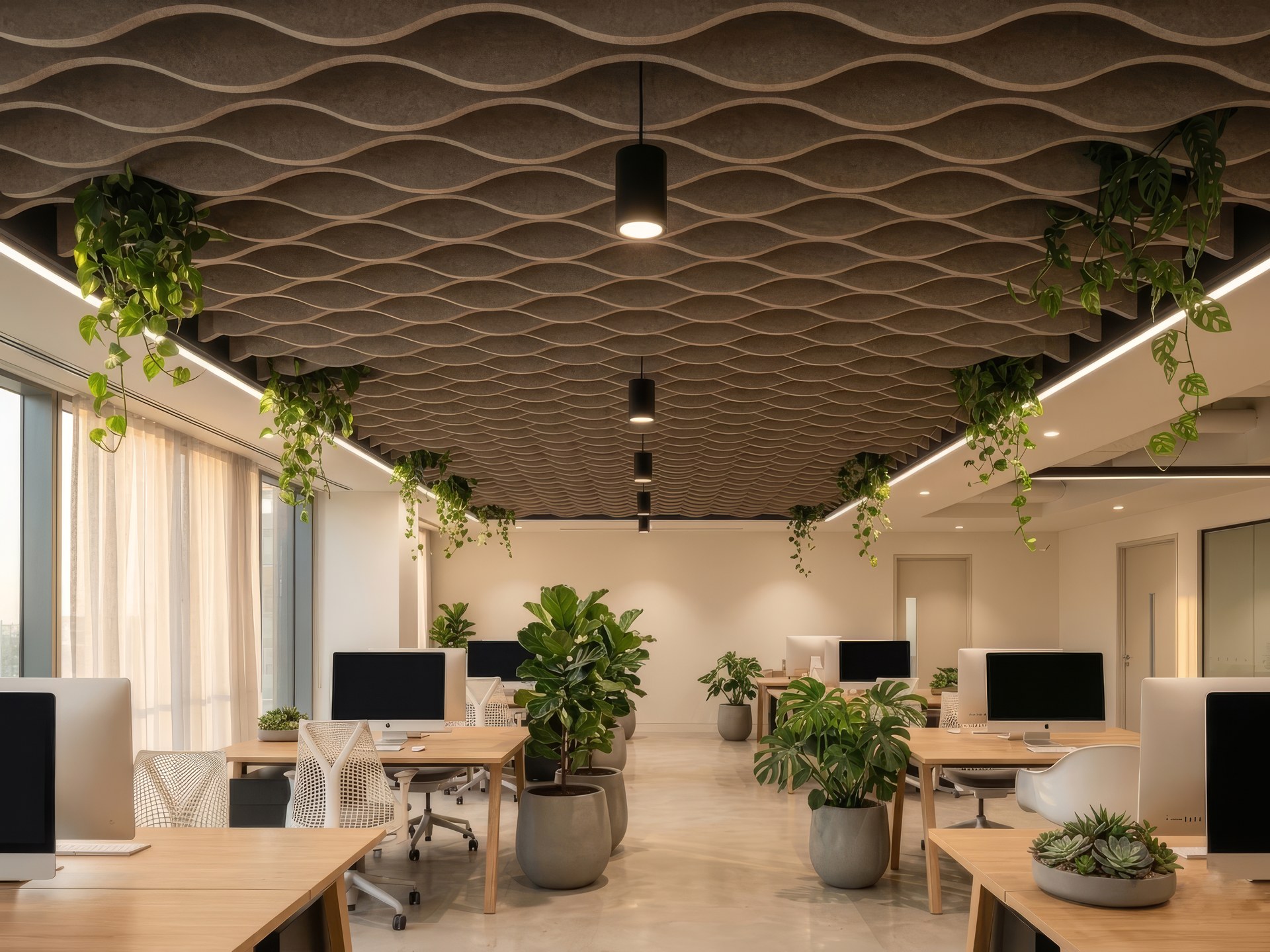
A direct-fix ceiling treatment using 12 mm PET panels with a 100 to 200 mm plenum gives you NRC 0.85 to 0.92 across the floor. For high-ceilinged offices (above 3.5 m), suspended baffles in linear runs work better. They absorb on both faces and the room above the baffle becomes part of the cavity.
Concrete numbers from a recent Whitefield install. 5,200 m² floor plate, suspended wave baffle in umber felt, 200 mm plenum. Reverberation time dropped from 1.4 seconds (untreated) to 0.6 seconds (target met). Speech intelligibility (STI) went from 0.42 to 0.66. Headphone usage on the floor dropped within the first month of occupancy.
Specify our acoustic baffles for tall plenum, our 12 mm plain panels for direct-fix at lower ceiling heights.
2. Acoustic back walls
The wall behind the workstations is the second-largest reflective surface and the easiest to treat. A continuous run of 12 mm plain acoustic panels on a 100 mm cavity-backed sub-frame gives you NRC 0.85 across the wall.
Cavity matters here. Direct-fix to gypsum board halves the absorption. Always detail a 25 mm or larger air gap, even when budget is tight. A battened sub-frame does the work cheaply.
Plain panels are stocked. We dispatch same day in Bangalore on payment, within a week anywhere in India. No customisation needed for plain wall coverage, so there is no production lead time.
3. Workstation screens between desks
Desk-mounted acoustic screens between facing workstations break the sight line between speakers and absorb voice-range frequencies before they cross. NRC 0.65 to 0.75 on a 12 mm felt screen at workstation height.
These do not solve the noise problem on their own. They solve a specific subset of it: the conversation at the desk one metre away. Combined with ceiling treatment, they take an open floor from “I can hear everything” to “I can focus on my screen”. Specify our desk-mounted screens at 400 to 500 mm height.
4. Acoustic baffles in horizontal runs over collaboration zones
Above seating zones (sofas, breakout tables, café seating), suspended acoustic baffles concentrate absorption where conversation density is highest. Linear runs at 100 mm centre-to-centre work better than scattered cloud panels for the same area.
Baffles also do useful aesthetic work. The visual rhythm of a parallel array reads as architecture, not as acoustic treatment. Architects find them easier to specify than ceiling-tile grids.
5. Phone booths for confidential calls
Sound transmission through walls is a different physics from absorption. Phone booths solve the speech-privacy problem for the person on the call. Plain acoustic panels do not solve confidential-call problems on their own.
Spec phone booths at one per 8 to 12 desks for a typical Indian SaaS / IT office. Less for sales-heavy floors. Acoustic treatment of the surrounding open floor reduces the noise leaking into the phone booth, but the booth’s own STC rating (sound transmission class) does the actual privacy work.
6. Soft furnishings
Carpet, fabric chairs, upholstered booths. Each adds distributed absorption across the floor. None of these is enough on their own. All of them matter cumulatively.
A carpeted floor versus a polished concrete floor changes the floor-plate absorption by roughly 20 to 30%. Worth doing if budget allows. Not a substitute for ceiling and wall treatment.
7. Sound masking, last resort
Sound masking systems play low-level filtered noise (think conditioned air-handler hum) that raises the ambient noise floor and makes nearby speech less intelligible.
It works. It is also the least-popular fix with users, who often describe it as “white noise that I notice but do not want.” Specify it only when the absorption-based fixes have been deployed and speech privacy is still failing. Not as a first move.
What does not work
1. “Aesthetic” panels with no NRC data
A panel that looks like an acoustic panel is not an acoustic panel unless it has been measured. We see this constantly: an architect specifies a printed pattern panel, a contractor sources a cheap version locally, and the installed product has unverified absorption. Sometimes it is genuinely useful. Often it is decorative felt that absorbs almost nothing.
Always insist on a test report before approving a panel. Not a marketing brochure. The actual ASTM C423 or ISO 354 lab report. (Read our guide on what to look for in an NRC report.)
2. Painted hard ceiling tiles
Mineral-fibre ceiling tiles painted on site to match a colour scheme. Paint coats the perforations and seals the porosity. NRC drops by 30 to 50% from the brochure number. The panel still looks acoustic, but it is now mostly reflective.
If you need a coloured acoustic ceiling, specify panels that are coloured through the material (like our 94-colour PET felt panels) rather than painted on top.
3. Foam egg-crate panels
The most-marketed acoustic product on Amazon. Convoluted polyurethane foam panels in 30 cm tiles, sold for “studio” or “home theatre” use. They look serious and they cost almost nothing.
They are also flammable, low-NRC at the frequencies that matter for office speech (most rate NRC 0.30 to 0.45), and visually intrusive. They are wrong for offices on every dimension. Architects specifying them in commercial projects are usually doing so because budget pressure ran them out of better options. There are better cheap options. A direct-fix acoustic ceiling in 9 mm PET panels costs less per m² than premium egg-crate foam and rates NRC 0.45 to 0.80 depending on cavity. The maths is not even close.
What changes in Bangalore
Three Indian-context notes that affect open-office acoustic design.
Humidity and HVAC noise. Bangalore’s HVAC runs hard for nine months of the year. Air handler diffusers add a constant low-mid frequency hum to every office. Acoustic treatment reduces speech reverberation but does nothing for HVAC noise. Coordinate with the M&E consultant on diffuser selection and duct lining alongside the panel spec. The acoustic panel is half the answer.
Glass meeting rooms. Indian offices over-use glass partitions for visual openness. Glass is acoustically reflective on both faces. Glass meeting rooms inside open offices reflect floor noise back into the floor and trap reverberation inside the meeting room. Treat the inside of the glass meeting room (back wall + ceiling) as a separate acoustic project. Without it, the glass room sounds boomy and the surrounding floor sounds louder.
Monsoon dust and PET durability. PET acoustic panels are dimensionally stable, hypoallergenic, and resist moisture. They survive Bangalore monsoons better than fibreglass or wood-fibre alternatives, both of which can absorb humidity and warp or grow mould.
The order of operations, in summary
- Ceiling first. Direct-fix or suspended baffle. NRC 0.85+ across the floor.
- Back walls next. 12 mm panels on 100 mm cavity. NRC 0.85.
- Desk-mounted screens between workstations. NRC 0.65 to 0.75.
- Phone booths for confidentiality, not for noise reduction.
- Soft furnishings as cumulative help.
- Sound masking only if 1 to 5 do not get you to target.
For step 1 and step 2, our 12 mm plain acoustic sheet in 94 colours is the working choice. Stocked, no customisation, dispatched same day in Bangalore on payment, delivered anywhere in India within a week. The acoustic data is published with full Intertek 2025 reports on our material page.
For project conversations or a boxed sample set, write to the studio or request samples.