What is NRC? An Indian architect's guide to noise reduction coefficients (2026)
How NRC is measured, what the single number actually tells you, why two panels with the same NRC can perform differently, and how to verify a manufacturer's claim. Written for architects and acoustic specifiers in India.
NRC is the most over-cited and under-explained number on an acoustic panel data sheet. Architects use it to compare products. Spec writers use it to satisfy a brief. Manufacturers print it on every brochure. And almost no one checks how it was tested.
This guide is for architects and interior designers in India who specify acoustic walls and ceilings. It explains what NRC measures, what it does not, how mounting and cavity depth change the same panel’s rating, and how to read a real test report when a sales rep hands you one. Every figure quoted here is grounded in our own ASTM C423-23 reports from Intertek Shanghai, March 2025.
What NRC actually is
NRC stands for Noise Reduction Coefficient. It is a single number, between 0.00 and 1.00, that summarises how much sound a material absorbs across the speech-frequency range.
The number is not measured directly. It is calculated by averaging the sound absorption coefficients at four octave-band centre frequencies. 250 Hz, 500 Hz, 1000 Hz, and 2000 Hz. The average is rounded to the nearest 0.05.
So NRC 0.85 means the material absorbs, on average, 85% of the sound energy that hits it across those four bands. NRC 0.00 reflects everything back. Concrete, glass, polished marble. NRC 1.00 absorbs everything. Practically nothing achieves a true 1.00, but soft fibrous materials with cavity depth come close.
The international standard that defines how this is measured is ASTM C423-23 in the US and India, and ISO 354 in Europe. Both describe a reverberation-room test. A panel sample is laid in a room with hard reflective walls, and the rate at which sound decays is measured before and after the sample is added. The difference gives you the absorption coefficient at each frequency.
This matters because the test is run in a controlled lab, not in your room. The number on the brochure is a property of the material plus its mounting, measured under specific conditions. It is not a guarantee of how the panel will perform on your wall.
The NRC scale, in plain terms
| NRC band | What it means in practice | Typical materials |
|---|---|---|
| 0.00 to 0.20 | Reflects most sound. Treat the room around it. | Glass, concrete, ceramic tile |
| 0.25 to 0.50 | Mild absorption. Useful as soft trim, not as primary treatment. | Carpet, heavy curtain, gypsum board |
| 0.55 to 0.75 | Working absorption. Suitable for most office and retail rooms. | Lightweight acoustic panels, perforated wood |
| 0.80 to 0.95 | Heavy absorption. Conference rooms, recording studios, auditoria. | Mineral wool, polyester acoustic felt at depth |
| 0.95 and above | Effectively full absorption. Specified when speech intelligibility is critical. | PET acoustic panel suspended over a deep cavity |
Most architectural specifications in India target NRC 0.65 to 0.85 for general commercial work. Auditoria, broadcast studios and recording spaces ask for 0.90 or above. Speech intelligibility, not noise reduction, becomes the design driver in those rooms.
Why NRC alone is not enough
A single number that averages four frequencies hides a lot.
Two panels can both rate NRC 0.80 and behave very differently in the room. One might absorb mostly at 1000 Hz and 2000 Hz, leaving the bass and lower mids untouched. The other might absorb evenly across the range. In a meeting room with male voices (fundamental frequency around 125 Hz), the second panel will sound clearer. In a coffee shop with espresso machines and chatter, the first panel might do enough.
The full data is in the octave-band absorption coefficients, not the headline NRC. A serious manufacturer will publish those numbers in their test report. We publish ours on the material page, 9 absorption curves across three panel thicknesses and three mounting conditions.
NRC also has a hard ceiling at 1.00. Some test reports show measured absorption coefficients above 1.00 at certain frequencies. This is not a measurement error. It is a known artefact of the reverberation-room method (called the edge effect), and it is reported as the actual value but capped at 1.00 in the published NRC. Read the octave-band data to see what is really happening.
Mounting changes everything
Here is the part that most architects miss. The same panel, made the same way, will rate completely different NRCs depending on how it is mounted.
ASTM C423-23 defines several mounting types. The two that matter for most architectural specifications:
- Type A mounting. Panel laid flat against a hard substrate. No cavity. This is the lowest-NRC condition for a given panel.
- Type E400 mounting. Panel suspended over a 400 mm air cavity. This simulates a typical suspended ceiling with a deep plenum.
Real numbers from our tests. A 12 mm KARIKA plain acoustic panel:
- Type A mounting (no cavity): NRC 0.60
- Type E200 (200 mm cavity): NRC 0.85
- Type E400 (400 mm cavity): NRC 0.92
Same panel. Same material. Different mounting. The number swings by 0.32. That is the difference between a meeting room that sounds good and one that sounds great.
If a brochure quotes NRC without the mounting condition, the number is meaningless. Always ask which mounting type the test was run under, and specify the same condition on your drawings. We cover the details of cavity selection in a separate article on cavity depth.
NRC targets by Indian project type
Rough working numbers we use when discussing briefs with Indian architects. These are not standards. They are practical starting points.
| Project type | Wall NRC target | Ceiling NRC target | Notes |
|---|---|---|---|
| Open-plan office | 0.70 to 0.85 | 0.80 to 0.95 | Ceiling matters more than walls in open plans |
| Private office | 0.65 to 0.80 | 0.75 to 0.85 | Speech privacy is the design driver |
| Conference / boardroom | 0.80 to 0.95 | 0.85 to 0.95 | Highest acoustic quality demand |
| Classroom | 0.70 to 0.85 | 0.85 to 0.95 | Speech intelligibility for back-of-room listeners |
| Auditorium / lecture hall | 0.85 to 1.00 | 0.85 to 1.00 | Sound system depends on absorption being right |
| Restaurant | 0.65 to 0.80 | 0.70 to 0.85 | Conversation legibility at adjacent tables |
| Recording studio | 0.90 to 1.00 | 0.90 to 1.00 | Octave-band data matters more than NRC |
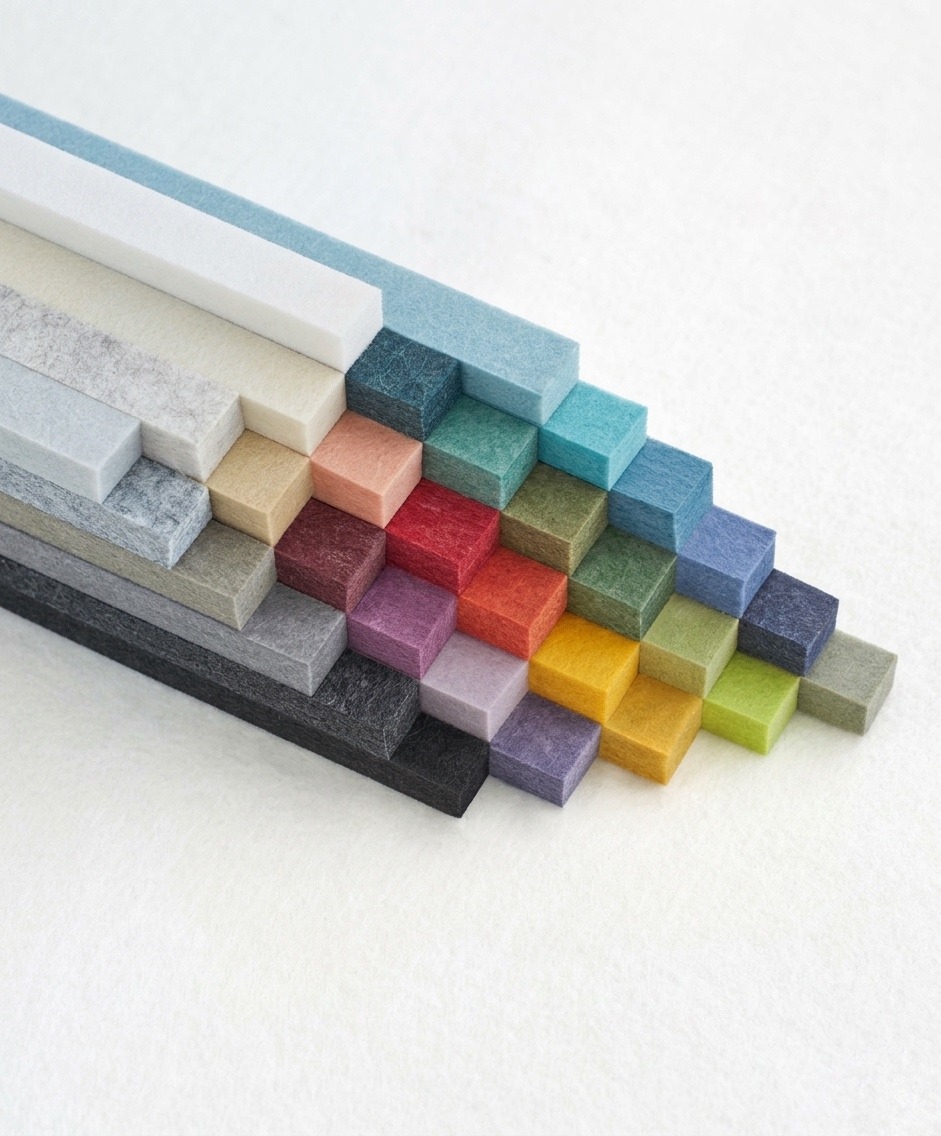
For office and education work in particular, our 12 mm plain acoustic sheets at NRC 0.85 with a 200 mm cavity are the most-specified configuration. They are stocked in 94 colours and dispatch same day in Bangalore.
How to verify a manufacturer’s NRC claim
Three checks before you trust a number on a brochure.
1. Ask for the test report. Not the marketing one-pager. The actual lab report from an accredited testing facility. It should name the lab, the test method (ASTM C423-23 or ISO 354), the test date, the sample dimensions, and the mounting type. Our reports are from Intertek Shanghai, March 2025.
2. Check the mounting type. As shown above, the same panel can swing 0.30 NRC between Type A and Type E400. If the report does not state the mounting type, the number is unverified. If the report uses an unusually deep mounting (E600 or larger) the published NRC will look better than the panel can deliver in any normal building.
3. Read the octave-band coefficients. A panel with NRC 0.80 that absorbs evenly across 250 to 2000 Hz performs differently from a panel with NRC 0.80 that peaks at 2000 Hz and drops off at 250 Hz. For meeting rooms, low-frequency absorption matters more than the headline number.
For our own panels, the full octave-band data is published on the material page, with all 9 absorption curves visible as an interactive chart. No login. No sales call.
Why PET acoustic panels rate the way they do
PET acoustic panels (the material we make at KARIKA) are a heat-bonded polyester fibre matrix. The matrix is porous. Sound enters the fibres, loses energy as friction, and exits reduced. The thicker and denser the matrix, the more friction. The wider the air gap behind it, the more low-frequency absorption.
A 9 mm PET panel runs roughly 2000 GSM. A 12 mm panel runs 2400 GSM. A 24 mm panel runs 4000 GSM. Headline NRC at direct mount climbs from 0.45 to 0.60 to 0.75 across these thicknesses. With a 150 mm cavity behind the panel, the same three thicknesses rate 0.85, 0.92 and 1.00. The cavity does more work than the thickness.
PET also has the benefit of being recyclable, low-VOC, and free of formaldehyde or fibreglass binders. For Indian projects that target IGBC or LEED ratings, it satisfies the EQ credits for low-emitting materials and the MR credits for recycled content (75% post-consumer in our case).
Final note for spec writers
If you take one practical move from this article: always specify the mounting condition alongside the NRC value on your drawings. “Acoustic panel, NRC 0.85” is incomplete. “Acoustic panel, NRC 0.85 at Type E200 mounting (200 mm cavity)” is a contractor brief that gets built right.
If you want a known anchor for your spec, the KARIKA 12 mm plain acoustic panel at Type E200 mounting rates NRC 0.85, verified by Intertek Shanghai, March 2025. The full nine-curve data is on our material page. The product itself is in stock. We dispatch plain sheets the same day in Bangalore on payment, and within a week anywhere in India. No customisation, no lead time, no surprises.
For project conversations, write to the studio or request a sample box. Both reach the same inbox.